Services
Process & System Optimization
With Veridian process and system improvements are no longer painful.


There's always room for improvement
Following an implementation, inefficiencies are common. With deep process and system expertise, Veridian is able to assist, so you can root out all inefficiencies, meet customer demands, and ensure your supply chain stays productive.
Change can be easy
Implementing system changes to match your process can be done quickly and with ease by utilizing Veridian's modern approach, automation tools, and proven methodology.

What is process and system optimization?
Process and system optimization is the work of making a live supply chain system and the operation it runs better: removing inefficiencies, aligning configuration with how the business actually works today, and adding capabilities the system already has but nobody switched on. With Veridian, process and system improvements are no longer painful. We make the change quickly, test it automatically and deploy it safely.
Why do live systems drift out of tune?
Following an implementation, inefficiencies are common. The design was made for the business as it was at go-live; volumes, SKUs, channels, customers and staff have all changed since. Workarounds accumulate on the floor. Configuration decisions made under go-live pressure are never revisited. Upgrades add features that never get adopted. None of this is a failure of the system; it is what happens to any system that is not actively tuned. With deep process and system expertise, Veridian is able to root out those inefficiencies so you can meet customer demands and keep your supply chain productive.
What does an optimization engagement look like?
- Assessment. We observe the operation, review configuration and data, and interview supervisors and associates. The output is a prioritized list of improvements with the expected benefit and effort of each.
- Quick wins. Changes that need only configuration, such as putaway and picking rules, wave criteria, replenishment settings, labor standards or task interleaving, are made first.
- Process redesign. Where the process itself needs to change, we redesign it with the people who run it and adjust the system to match, not the other way around.
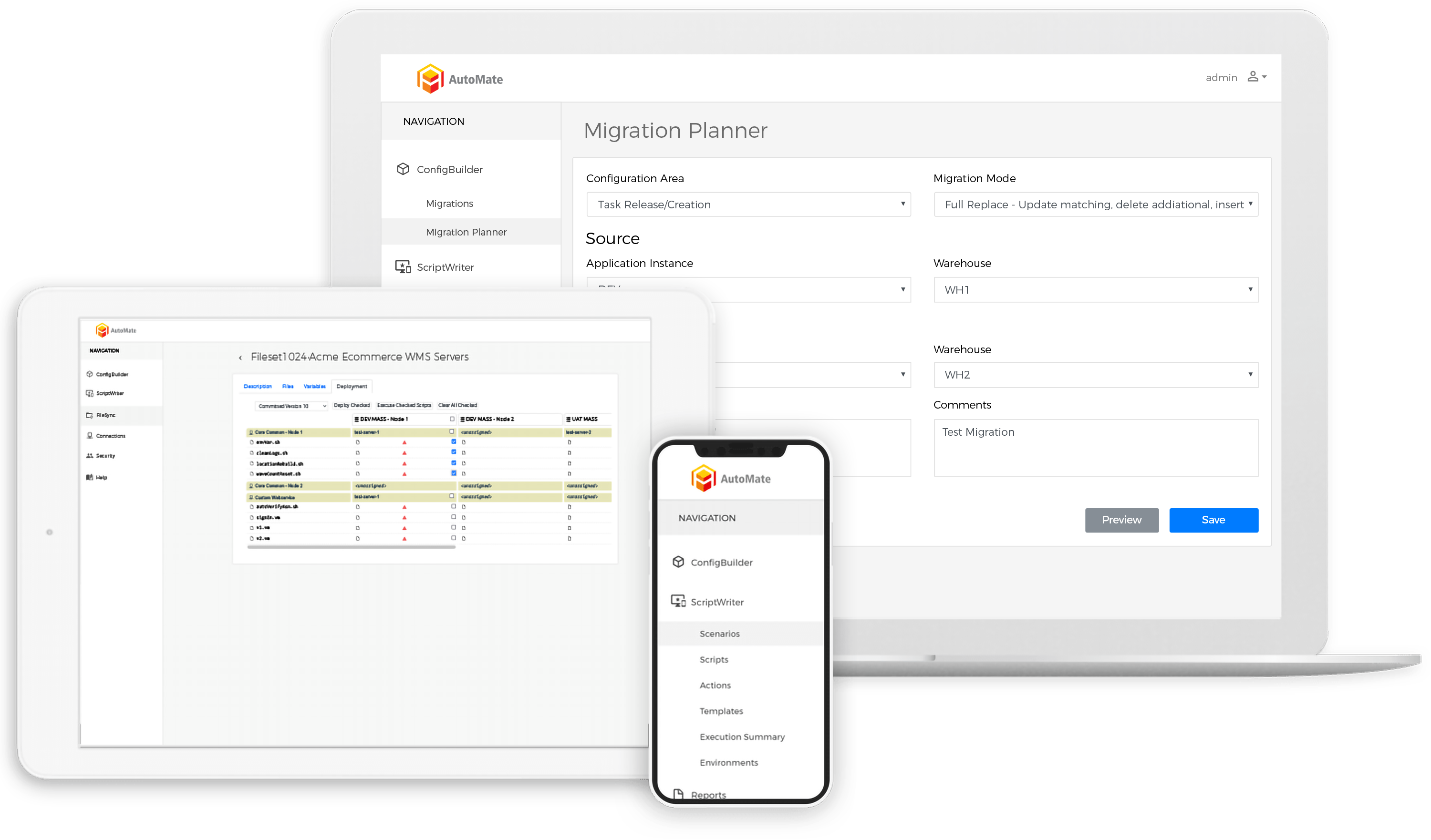
- Automated testing and controlled deployment. Every change is scripted and regression-tested with ScriptWriter, migrated between environments with ConfigBuilder and deployed with FileSync, so improvements do not introduce new problems.
- Measure and repeat. We track the metrics that matter (throughput, accuracy, labor productivity, cycle time) and keep going.
Where does optimization usually pay off?
| Area | Typical symptoms | What changes |
|---|---|---|
| Inbound and putaway | Dock congestion, product staged for hours, putaway to the wrong zone. | Receiving rules, putaway strategies, cross-dock and location logic. |
| Waving and picking | Long travel paths, waves released too early or too late, pick errors. | Wave criteria, pick strategies, slotting, task interleaving. |
| Packing and shipping | Carton selection by guesswork, carrier cut-offs missed, compliance chargebacks. | Cartonization, pack station flow, carrier and label configuration. |
| Inventory | Cycle count backlog, phantom inventory, shrink. | Count programs, exception workflows, adjustment controls. |
| Labor | Standards nobody trusts, uneven workloads. | Engineered standards, labor management configuration, reporting. |
| Integration | Orders or receipts stuck between systems, manual re-keying. | Interface tuning, error handling, monitoring. |
What does the client provide?
Access to the facility and to the data (orders, inventory, labor and system logs), a business owner who can approve process changes, and time from supervisors and super-users for review and testing. Veridian brings the analysis, the configuration and process expertise, and the automation tools.
Deliverables, duration and team
Clients receive an assessment report with a prioritized improvement backlog, the implemented configuration and process changes, automated test coverage for everything that was touched, updated procedures, and a benefits summary. An assessment is typically completed in weeks; implementing the backlog can be a short project or a continuous program, depending on what the client wants. Teams are small, usually a senior consultant with support from Veridian's automation specialists.
How does this fit with Manhattan Associates and AutoMate?
Veridian specializes in the optimization of Manhattan Associates WMS and OMS and knows where their capabilities sit. Our AutoMate suite was built for exactly this work: ConfigBuilder migrates configuration between environments so a change is set up and validated once, ScriptWriter runs tests automatically when a change is introduced, and FileSync deploys files across the enterprise with version history. That is what makes change easy instead of risky.
When does a company need optimization?
- The system has been live for a while and the operation has changed around it.
- Throughput, accuracy or labor cost is not where the business case said it would be.
- You are adding automation, a new channel or a new customer with different requirements.
- A Manhattan Associates upgrade has added capabilities you have not adopted.
Frequently asked questions
Do we need to be a Veridian implementation client to use optimization services?
No. Veridian optimizes systems it did not implement. The assessment starts by understanding how the system was configured and how the operation runs today.
How is a change made safely in a live system?
Every change is built in a non-production environment, regression-tested with automated ScriptWriter scenarios, migrated with ConfigBuilder and deployed with FileSync, so production only receives validated changes.
What results does optimization typically target?
Throughput, order and inventory accuracy, labor productivity, cycle time and the elimination of manual workarounds. The assessment quantifies the expected benefit of each improvement before work begins.
How long does an optimization assessment take?
An assessment is typically measured in weeks. Implementing the resulting backlog can be a short project or an ongoing program, depending on the client's priorities.
Is optimization the same as an upgrade?
No. An upgrade moves the system to a newer release; optimization improves how the system and the process work together on any release. The two are often combined so new capabilities are adopted as part of the upgrade.
Software to support your needs
Save time with automated configuration, no-code scripting, and file management solutions made simple.
Preferred implementation partner of:
Meet customer demands and improve efficiency
Ensuring a successful implementation has never been easier with the help of Veridian’s modern approach to supply chain technology, expert staff, and automation tools.

Meet customer demands and improve efficiency
Ensuring a successful implementation has never been easier with the help of Veridian’s modern approach to supply chain technology, expert staff, and automation tools.