Manhattan’s Momentum 2026 Just Rewrote the Rules for WMS Implementations
Key takeaways
- At Momentum 2026 (May 18-21, Las Vegas) Manhattan Associates launched Solution Design Studio: business users describe processes in plain English and AI agents generate Manhattan Active Warehouse configuration.
- Manhattan Marketplace is a shared ecosystem where customers and partners publish and deploy agents, extensions and accelerators that run natively on ActivePlatform.
- Nine production agents, including a Wave Coordinator Agent in use at Giant Eagle, operate with human-guided autonomy.
- Agent Foundry now supports Google's Agent-to-Agent protocol and Anthropic's Model Context Protocol, so Manhattan agents can work with agents on other platforms.
- Manhattan customers should define an agent strategy, revisit how upcoming implementations will be run, and watch the Marketplace.
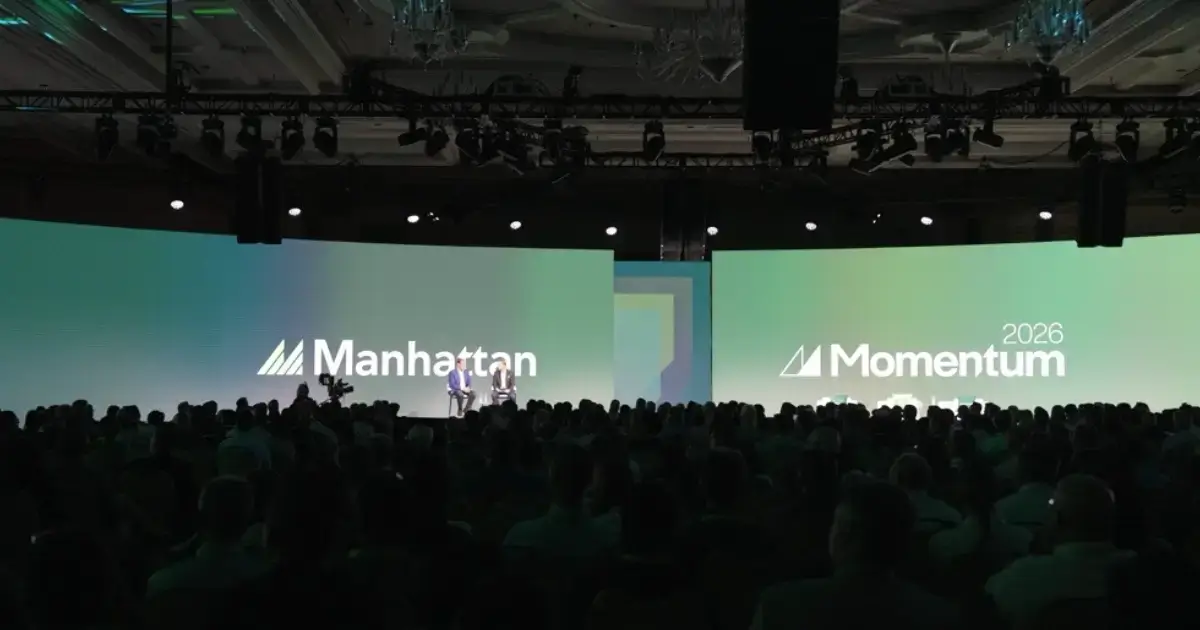
At Manhattan Associates’ annual Momentum conference last week in Las Vegas, the company didn’t just talk about AI. It showed what happens when you hand AI the keys to system configuration, agent deployment, and partner ecosystem development all at once. For anyone involved in supply chain technology, particularly warehouse management, order management, or omnichannel operations, the announcements from May 18-21 at the Bellagio represent a genuine inflection point in how these systems get built and run.
We’ve been implementing Manhattan solutions for years. What we saw at Momentum 2026 changes the math on implementation timelines, ongoing optimization, and the skill sets that supply chain teams need going forward.
Here’s what happened, what it means, and why it matters right now.
Solution Design Studio: From Months of Configuration to Minutes
The headline announcement was Solution Design Studio, a new AI-powered workspace inside Manhattan’s ActivePlatform. The concept is straightforward but the implications are enormous: business users describe what they want their supply chain system to do in plain English, and AI agents translate those descriptions into working system configurations.
Manhattan calls the natural language descriptions “blueprints.” A warehouse operations director could write something like “I need a receiving process that handles both ASN-based and blind receipts, with quality inspection triggered for temperature-sensitive items, and automatic putaway to reserve storage by product category.” The AI agents parse that intent, generate the corresponding configuration across Manhattan Active Warehouse, and deploy it.
During testing, Manhattan reported that agents autonomously configured most of ActiveWarehouse’s functionality. Work that historically consumed months of consultant time and dozens of configuration sessions compressed into minutes.
Let that sink in for a moment.
If you’ve ever sat through a 16-week WMS implementation, you know that a huge portion of that timeline isn’t spent on hard technical problems. It’s spent on translation. Business users explain their processes. Consultants interpret those explanations. Configuration specialists build settings. Testers verify that the settings match the original intent. Errors get caught, corrected, and retested. Solution Design Studio attacks that entire translation layer.
Manhattan’s services teams are already using the tool in targeted engagements. It’s not a demo or a roadmap item. It’s running.
For implementation partners and customers, the questions this raises are practical and immediate. What does a WMS project timeline look like when configuration drops from weeks to hours? How do you staff differently? What happens to the testing cycle when the AI can validate its own output against the original blueprint? These aren’t theoretical questions anymore.
Manhattan Marketplace: An App Store for Supply Chain Intelligence
The second major announcement was Manhattan Marketplace, a shared ecosystem where customers, partners, and Manhattan itself can publish, discover, and deploy intelligent agents, extensions, and accelerators. Everything in the Marketplace runs natively on the ActivePlatform.
Think of it as an app store for supply chain operations, but with a critical difference: the “apps” are AI agents and platform extensions that plug directly into your live Manhattan environment. A partner builds an agent that optimizes labor scheduling for cold storage facilities. They publish it to the Marketplace. A grocery distributor running Manhattan Active Warehouse finds it, evaluates it, and deploys it without a custom integration project.
This builds on Agent Foundry, the custom agent development platform Manhattan launched at Momentum 2025. Agent Foundry gave technical teams the tools to build agents. Marketplace gives those agents a distribution channel and gives customers a way to find solutions they didn’t know existed.
Partners are already developing content for the Marketplace. The network effects here could compound quickly. Every new agent published makes the ecosystem more valuable for customers, which attracts more customers, which incentivizes more partners to build agents. Manhattan has been a single-vendor platform for most of its history. Marketplace turns it into a multi-contributor ecosystem.
Nine Production Agents (and Counting)
Beyond the platform announcements, Manhattan showcased an expanded roster of production-ready autonomous agents embedded across its Active solutions. These aren’t prototypes or lab experiments. They’re running in customer environments with governance controls and human oversight built in.
The lineup includes:
- Wave Coordinator Agent is already in use at Giant Eagle, autonomously managing wave planning and release across distribution operations.
- Intelligent Store Manager handles store-level inventory and fulfillment decisions.
- Labor Optimizer Agent balances workforce allocation across facility operations in real time.
- Wave Inventory Research Agent investigates and resolves inventory discrepancies that would otherwise stall wave processing.
- Contextual Data Assistant provides natural-language access to operational data across Manhattan Active solutions.
- Virtual Configuration Consultant guides users through system setup and configuration changes.
- Store Associate Agent supports in-store staff with task prioritization and inventory lookup.
- Contact Center Agent handles customer service interactions with order visibility and resolution capabilities.
- OMS Configuration Agent assists with order management system setup and modification.
The Giant Eagle deployment is particularly notable because it’s a named customer running a production agent in a live distribution environment. This isn’t “we have a pilot with an unnamed Fortune 500 company.” It’s a regional grocery chain trusting an autonomous agent with wave coordination, one of the most operationally sensitive functions in a distribution center.
Manhattan’s approach to agent governance deserves attention too. Every agent operates with what the company describes as human-guided autonomy, meaning agents take action within defined guardrails but escalate to human operators when they encounter situations outside their boundaries. That’s the right architecture for supply chain operations where a bad decision can cascade through an entire facility in minutes.
Agent Foundry Gets Interoperable
Agent Foundry, originally launched at Momentum 2025, received significant updates. The most important: compatibility with both Google’s Agent-to-Agent (A2A) protocol and Anthropic’s Model Context Protocol (MCP). This means agents built on Manhattan’s platform can communicate with agents running on other platforms, including Google Agentspace.
Why does interoperability matter? Because no enterprise runs a single platform. A company might use Manhattan for warehouse and order management, SAP for ERP, Salesforce for CRM, and a specialized TMS for transportation. If agents on each platform can only talk to other agents on the same platform, you’ve just recreated the integration silo problem that the industry has spent two decades trying to solve.
A2A and MCP support means a Manhattan warehouse agent could coordinate with a transportation agent running on a different platform, or pull context from an ERP agent, without custom point-to-point integrations. That’s table stakes for the “agentic era” Manhattan is promoting, and they’re one of the first supply chain vendors to build it in natively.
What “Intent-Based Engineering” Actually Means in Practice
Manhattan’s framing for Momentum 2026 was “Welcome to the Agentic Era,” but the more useful concept underneath the branding is what they’re calling intent-based engineering. The idea: humans define the “what” and machines generate the “how.”
That’s not a new idea in software broadly. Infrastructure-as-code, declarative programming, and low-code platforms have all worked toward similar goals. But applying it to supply chain system configuration is new, and it addresses a real bottleneck.
The supply chain technology industry has a persistent talent problem. There aren’t enough people who understand both the business operations and the technical configuration of these systems. Every implementation partner, Veridian included, has felt that constraint. The pool of consultants who can translate a client’s receiving process into Manhattan Active Warehouse configuration is finite, and demand for those skills keeps growing.
Intent-based engineering doesn’t eliminate the need for that expertise. But it changes where the expertise gets applied. Instead of spending 70% of their time on configuration mechanics and 30% on strategic design, implementation consultants could flip that ratio. More time on process optimization, exception handling, and competitive differentiation. Less time on screen-by-screen data entry.
What This Means for Supply Chain Teams Right Now
If you’re running Manhattan Active solutions today, three things should be on your radar immediately.
First, start thinking about your agent strategy. Manhattan now has a growing library of production agents, a platform for building custom ones, and a marketplace for distributing them. The organizations that move early on identifying which operational decisions can be delegated to agents, with appropriate guardrails, will pull ahead of those that wait.
Second, evaluate your implementation and optimization approach. Solution Design Studio will change how new deployments and major reconfigurations happen. If you’re planning a Manhattan project for late 2026 or 2027, the methodology may look fundamentally different from what you’d have scoped six months ago.
Third, watch the Marketplace closely. The value of any platform ecosystem is proportional to the quality and breadth of its content. As partners and customers publish agents and extensions, there will be opportunities to solve operational problems that previously required custom development.
The Momentum 2026 announcements aren’t incremental improvements to existing products. They represent a structural change in how supply chain systems get designed, configured, operated, and extended. Manhattan is betting that the future of supply chain technology is less about screens and settings and more about intent and agents.
Based on what we saw in Las Vegas, that’s a bet worth paying attention to.
If you would rather see the demos than read about them, Manhattan Associates has been publishing Momentum 2026 session highlights on its YouTube channel, including day-one keynote coverage and customer stories from the event.
Veridian is a Manhattan Associates implementation partner specializing in warehouse management, order management, and supply chain optimization. Contact us to discuss how the Momentum 2026 announcements apply to your operations.