UPS Just Proved the Math on Warehouse Automation. The Numbers Are Hard to Argue With.
Key takeaways
- UPS says it costs 28% less to process a package in an automated facility; 68.5% of U.S. volume now moves through automated buildings, up from 64% a year earlier.
- The Network of the Future plan closes roughly 200 facilities, adds 24 automated buildings in 2026 and targets about 400 automated facilities by 2028, eliminating 50 million hours and nearly 78,000 positions.
- Deployments include about $120 million for 400 Pickle Robot truck unloaders and 700-plus Geek+ robots at UPS Velocity handling more than 350,000 units a day.
- For mid-market operators, labor is 60-70% of operating cost, automation typically cuts it 20-40%, and paybacks run two to four years; BLS data show warehouse wages up roughly 22% since 2020.
- UPS targets $3 billion in annual savings by 2028 and is lifting volume-per-resource from 51 in 2023 to 59 in 2026.
There’s a number floating around the logistics world right now that should make every warehouse operator stop and recalculate their five-year plan: 28%.
That’s how much less it costs UPS to process a package in an automated facility compared to a conventional one. CEO Carol Tomé dropped that figure during the company’s Q2 2026 earnings call last week, and it landed with the kind of quiet authority that only comes from running the math on hundreds of millions of packages. Not a projection. Not a vendor’s slide deck. An operational result from one of the largest logistics networks on the planet.
At the end of Q2, 68.5% of all U.S. volume flowing through UPS moved through buildings equipped with automation. That’s up from 64% just a year ago, and it translates to 337 million additional packages handled by machines instead of human hands. The trajectory is clear, and UPS isn’t slowing down.
From 200 Buildings Closed to a Leaner Network
UPS’s “Network of the Future” initiative didn’t start as an automation project. It started as a hard look at an overgrown network that had accumulated facilities the way old companies accumulate conference rooms: one at a time, until nobody could explain why there were so many.
The plan called for closing roughly 200 sorting hubs and facilities. Dozens have already shut down, with more closures scheduled through the rest of 2026. But this isn’t just about shrinking. UPS is simultaneously converting existing sites and adding 24 new automated buildings to its network this year, bringing the total automated roster well past its earlier base of 127 buildings. The company’s long-term target is roughly 400 automated facilities by 2028.
EVP and CFO Brian Dykes put the human cost in stark terms during the earnings call: “We will have eliminated 50 million hours through the course of last year and this year, nearly 78,000 operational positions that were associated with that volume, and we’ll close nearly 150 buildings.”
Those aren’t abstract numbers. They represent a complete rethinking of how a parcel network should be structured when you can deploy pick-and-place robotics, autonomous guided vehicles, truck-unloading robots, and AI-driven routing systems at scale.
The 28% Question Every Operator Should Be Asking
The 28% cost reduction per package isn’t just a UPS story. It’s a data point that validates what the automation industry has been claiming for years, and it comes from an operator running at a scale that makes the finding hard to dismiss as a niche result.
For context, labor typically accounts for 60% to 70% of operating costs in manual parcel sorting operations. Industry research consistently shows that automated sorting systems reduce labor costs by 20% to 40%, with payback periods running two to four years for large-scale facilities. UPS’s 28% figure sits right in that range, but with a sample size that dwarfs most case studies.
The economics work because automation attacks the most expensive and least flexible part of warehouse operations: repetitive manual tasks. Unloading trailers, sorting packages by destination, moving goods through a facility. These jobs are physically demanding, hard to staff consistently, and scale poorly. When volume spikes (think peak season or a tariff-driven import surge), manual operations require overtime, temporary workers, and the error rates that come with both.
Automated systems don’t eliminate the complexity. But they change where the complexity lives. Instead of managing hundreds of temporary workers during a peak, you’re managing throughput rates and maintenance schedules. The per-unit cost stays flat whether you’re processing 100,000 packages or 300,000.
What UPS Is Actually Deploying
The technology inside UPS’s automated buildings isn’t science fiction. Most of it has been commercially available for years. What’s changed is the willingness to deploy it at network scale and the financial results that justify continued investment.
UPS has committed approximately $120 million to Pickle Robot for 400 truck-unloading units, with deployments starting across multiple facilities. These robots handle the grueling work of pulling packages off trailers, a job that’s been one of the hardest to staff and one of the most common sources of workplace injuries in distribution.
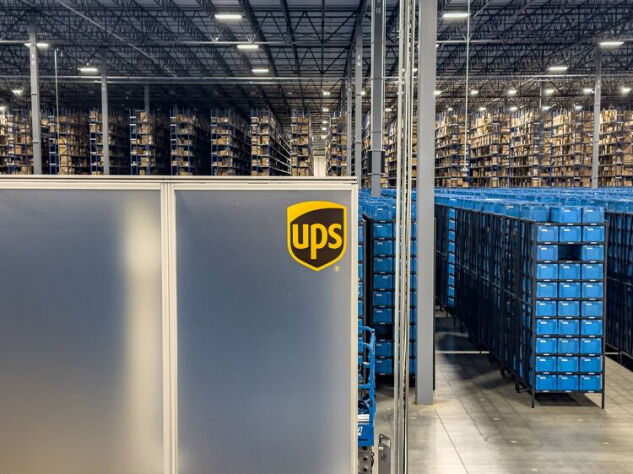
The company’s partnership with Geek+ has produced facilities like UPS Velocity, where more than 700 shelf-to-person robots handle sorting, storage, and order processing at rates exceeding 350,000 units per day. The robots move autonomously through the facility, bringing goods to stationary workers who handle the tasks that still require human judgment.
Singulators, high-speed conveyors, and AI-powered routing systems round out the picture. The AI component is worth noting specifically: machine learning models now help determine optimal package routing through the network, prioritizing shipments based on service level, destination, and available capacity. It’s not the kind of AI that makes headlines, but it’s the kind that compounds savings across billions of annual touches.
The Amazon Factor
There’s a subplot to UPS’s automation story that makes the numbers even more interesting. The company recently finished reducing its Amazon delivery volume by about 2 million packages per day, an initiative that kicked off in 2025. Tomé described the removed Amazon volume as “lower quality,” meaning it carried thinner margins and higher handling costs.
By shedding that volume and simultaneously automating, UPS has essentially rebuilt its network for profitability rather than pure throughput. “We now have a leaner, more automated, more agile network that will deliver operating leverage as volume grows,” Tomé said.
This is a strategic move that smaller operators can learn from, even if they can’t replicate the scale. The principle is the same: don’t automate everything indiscriminately. Automate the work that drives the most cost, shed the work that doesn’t generate adequate returns, and build flexibility into what remains.
What This Means for Mid-Market Warehouse Operators
UPS can spend $9 billion on network transformation. Most warehouse operators can’t. But the underlying economics don’t require UPS-scale capital to work.
The payback math is straightforward. If labor represents 65% of your operating costs and automation reduces that by 30%, you’re looking at roughly a 20% reduction in total operating expense. For a facility spending $5 million annually on operations, that’s $1 million per year in savings. A $3 million automation investment pays for itself in three years, and the savings compound as labor costs continue to rise.
And labor costs are rising. The Bureau of Labor Statistics reports that warehouse wages have increased roughly 22% since 2020, and the labor pool hasn’t expanded to match demand. Operators in tight labor markets (Southern California, the Northeast corridor, major metro areas) are already feeling the squeeze. Automation doesn’t just reduce cost per unit. It reduces the operational risk of not being able to staff your building during peak periods.
The technology has also become more modular. Five years ago, automating a facility meant a massive capital project with 18 months of implementation. Today, companies like Locus Robotics, 6 River Systems, and Geek+ offer robotics-as-a-service models that let operators add capacity incrementally. You can start with automated goods-to-person picking, prove the ROI, and expand from there.
The Productivity Metric That Matters
UPS tracks a metric called “volume-per-resource,” defined as average daily volume divided by U.S. employees. In 2023, that number was 51. The target for 2026 is 59, a 15.7% improvement in per-worker productivity.
That single metric captures the entire automation thesis. You’re not just replacing workers with robots. You’re fundamentally changing the ratio of output to human input. The workers who remain are doing higher-value work: managing systems, handling exceptions, maintaining equipment, and making decisions that machines can’t.
For operators evaluating automation investments, this is the metric to track. Not just labor cost reduction, but output per person. It accounts for the fact that automation often shifts labor from direct handling to supervision and maintenance, which is a different cost profile but not zero.
The $3 Billion Target
UPS has set a target of $3 billion in annual cost savings from its network transformation by the end of 2028, with approximately $1.5 billion expected by the close of 2026. Those numbers include savings from facility closures, network optimization, and technology deployment.
The scale of the target tells you something about how much inefficiency existed in the old network. But it also tells you something about where the logistics industry is headed. When the largest parcel carrier in the world publicly commits to this level of automation investment and reports results that validate the thesis, the rest of the industry takes notice.
The question for warehouse operators isn’t whether automation works. UPS just answered that with 337 million packages and a 28% cost reduction. The question is how quickly you can get started, and what happens to your competitive position if you don’t.
Velocity, in a 70-second time-lapse
Geek+, the robotics vendor behind the site, published a 70-second time-lapse of UPS’s Velocity facility scaling up. It is the quickest way to get a feel for the density of a goods-to-person floor that processes up to 350,000 units a day.
The footage is from early 2024, two years before the results discussed above, which is the point: the 28% cost reduction UPS reported is the payoff from investments like this one compounding over several years, not a single quarter’s project.