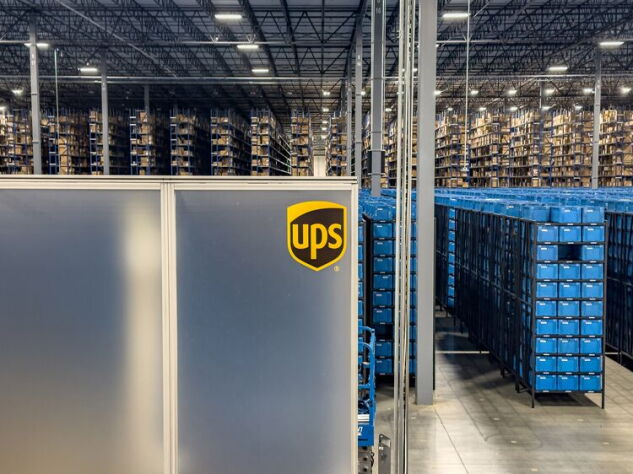
Locus Robotics Just Built a Warehouse That Runs Itself. Here’s How.
Key takeaways
- Locus Robotics announced Locus Array, combining mobile robots, an integrated picking arm and AI perception; DHL Supply Chain is running it in live operations.
- Locus claims up to a 90% reduction in manual labor across picking, putaway, induction, slotting and replenishment.
- The Robots-to-Goods model sends robots to the inventory to execute tasks in the aisle instead of bringing goods to a station.
- Array is sold through Robotics-as-a-Service and is designed to deploy in weeks without facility redesign.
- Open questions: long-tail SKUs, per-unit economics at scale and the depth of WMS integration.

The warehouse robotics industry has been talking about “lights-out” fulfillment for years. Fully autonomous facilities where robots handle everything from picking to putaway, with no human hands touching a single item. It’s been a good sales pitch. It hasn’t been reality.
That changed on May 3, when Locus Robotics announced Locus Array, a system the company describes as a “fully autonomous fulfillment system.” It combines mobile robots, a robotic picking arm, and AI-powered perception into one coordinated unit that can handle end-to-end warehouse workflows without manual intervention. DHL Supply Chain is already running it in live operations. And the numbers Locus is claiming, if they hold up, are significant: a 90% reduction in manual labor across picking, putaway, induction, slotting, and replenishment.
That’s not incremental improvement. That’s a different operating model.
The Problem Locus Array Is Solving
Warehouse automation has come a long way since the first conveyor belts and sortation systems showed up on distribution center floors. But most of it still works the same way: move products to people, or move people to products, and let humans do the fine-motor work of grabbing, scanning, and placing items.
The collaborative robot wave that started around 2018 improved things. Companies like Locus, 6 River Systems (now owned by Ocado), and Geek+ deployed tens of thousands of mobile robots that follow workers through aisles, carry totes, and reduce walking time. According to a 2026 study by Peerless Research Group and Modern Materials Handling, 49% of warehouses now use conveyor and sortation systems, while 48% have deployed goods-to-person picking solutions. The industry is spending real money here. Global investment in warehouse automation hit $21 billion in 2023 and is projected to exceed $90 billion by 2033.
But there’s a persistent gap. Most deployed robotics still require a human somewhere in the loop. The robot brings the shelf to you, but you still pick the item. The automated guided vehicle moves the pallet, but someone has to load it. Fully autonomous systems that can handle the actual manipulation of individual items, at the speed and accuracy required for order fulfillment, have remained stubbornly out of reach.
That gap is what Locus Array targets.
What Locus Array Actually Does
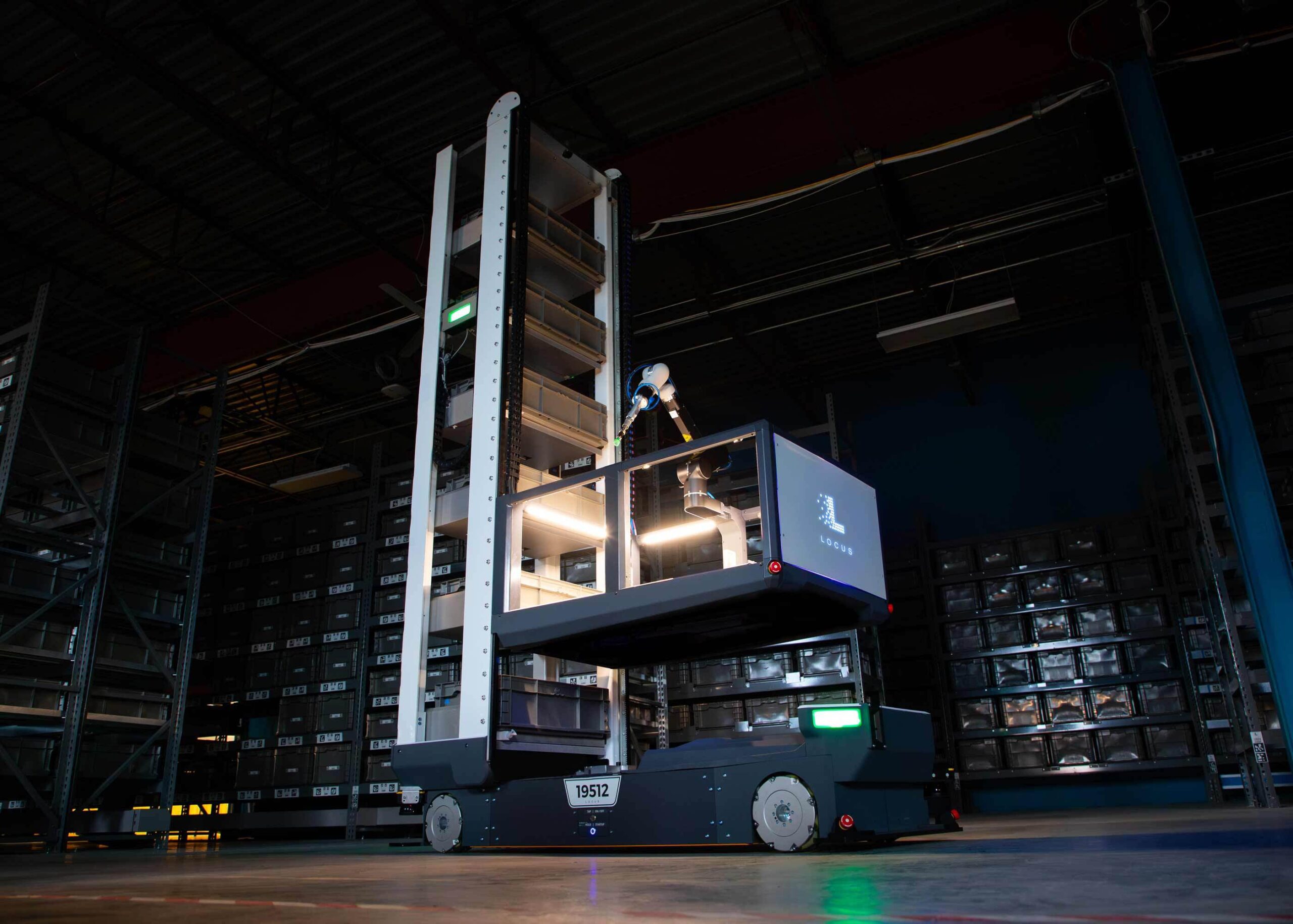
Instead of the traditional “goods-to-person” model, where items travel on conveyors or are carried by robots to a picking station, Locus Array introduces what the company calls “Robots-to-Goods” (R2G). The robots go directly to inventory in the aisle and execute fulfillment tasks on the spot.
Here’s the practical breakdown. Locus Array combines three things into one system:
Mobile robotics platform. The base unit navigates warehouse aisles autonomously, positioning itself in front of the correct storage location. It works alongside Locus Origin and Locus Vector, the company’s existing mobile robot lines, sharing the same navigation infrastructure and orchestration layer.
Integrated robotic picking arm. This is the component that closes the automation gap. The arm handles the physical manipulation of items: picking from shelves, placing into totes, executing putaway, and managing replenishment. Locus hasn’t published detailed specs on the arm’s payload capacity or items-per-hour throughput, but the 90% labor reduction claim implies serious capability.
AI-powered perception and orchestration. The system runs on LocusONE, the company’s AI orchestration platform. It dynamically assigns work based on real-time demand, coordinates multiple robots operating simultaneously, and adapts to changing conditions like shifting SKU profiles or demand spikes. Think of it as the traffic controller and task manager rolled into one.
The deployment model matters too. Locus is offering Array through its existing Robotics-as-a-Service (RaaS) subscription, which means no massive capital expenditure upfront. The company claims deployment takes weeks, not months, and doesn’t require facility redesign. That’s a big deal for operations that can’t afford to shut down a warehouse for a retrofit.
Why DHL’s Involvement Matters
DHL Supply Chain isn’t just a customer reference on a press release. The company operates more than 2,000 warehouses across 220 countries and territories. When DHL commits to a technology, it carries weight.
Sally Miller, DHL’s global chief information officer, called the deployment a move “beyond traditional assisted picking into a new era of high-density, autonomous fulfillment.” More telling is DHL’s focus on vertical space utilization. One of the persistent limitations of human-centric picking is that you need to design storage around human reach. Automated systems like Array can potentially access higher shelving positions, increasing storage density without expanding the building’s footprint.
DHL has been on a years-long digitalization push, investing heavily in robotics across its network. The company has previously deployed Locus robots at scale, so this isn’t a cold-start pilot. It’s an expansion of an existing partnership into more capable technology. That trajectory, from collaborative robots to fully autonomous systems within the same vendor ecosystem, is likely the path many large operators will follow.
The Bigger Picture: Where Warehouse Automation Is Headed
Locus Array isn’t the only system pushing toward full autonomy. Symbotic (backed by Walmart) has been deploying AI-powered robotic systems in distribution centers. Ocado’s technology powers automated fulfillment for grocery retailers worldwide. Amazon continues building out its own robotic infrastructure, with the Sparrow and Sequoia systems handling sorting and storage.
But what makes the Locus approach notable is its focus on retrofit compatibility. Most fully automated systems (Symbotic, Ocado, AutoStore) require purpose-built facilities or significant infrastructure modifications. They work best in greenfield deployments. Locus Array is designed to drop into existing warehouses, work within current racking layouts, and scale incrementally.
That distinction matters because the vast majority of warehouses in operation today weren’t built for automation. The Peerless Research study found that 33% of companies say their picking operations are mostly or fully manual with no plans to automate. Another 35% report only partially automated retrieval. For these operations, a system that deploys in weeks without facility redesign could lower the barrier to entry significantly.
The Robotics-as-a-Service pricing model lowers it further. Instead of a multi-million dollar capital project, operators pay a per-robot subscription fee. If volumes drop, they can scale down. If a new facility opens, they can redeploy units. It’s the same consumption-based approach that transformed enterprise software, now applied to physical automation.
What to Watch For
There are legitimate questions that Locus still needs to answer. The 90% labor reduction claim is dramatic, and real-world performance across different SKU profiles (small items, fragile goods, irregularly shaped products) will determine whether that number holds up outside controlled environments.
Picking arms have historically struggled with the “long tail” of warehouse SKUs. The most common 20% of products are usually straightforward to automate, but the remaining 80% include odd shapes, varying weights, and packaging that confuses computer vision systems. How Locus Array handles that variety will be the real test.
There’s also the question of cost. RaaS subscriptions make the entry price manageable, but the per-unit economics need to work at scale. If a warehouse needs 50 Array units to replace a 100-person picking team, the math has to pencil out against labor costs in specific markets. A warehouse in rural Tennessee has different labor economics than one in the Inland Empire.
And integration with existing WMS platforms will matter. Locus has partnerships with major WMS vendors, but the depth of integration required for fully autonomous operation (real-time inventory updates, dynamic slotting changes, exception handling) goes well beyond what collaborative robots demanded.
The Bottom Line
Fully autonomous warehouse fulfillment has been a “next year” technology for the better part of a decade. Locus Array represents a credible attempt to make it “this year.” The combination of mobile robotics, robotic picking, and AI orchestration in a single, retrofit-friendly, subscription-priced system addresses the practical barriers that have kept most warehouses stuck in the “partially automated” category.
Whether it delivers on its promises at scale remains to be seen. But with DHL running it in live operations and the broader market accelerating toward $90 billion in automation spending by 2033, the direction is clear. The warehouse of the future won’t just have robots in it. It will be run by them.
Locus Array in action
Claims about “fully autonomous” fulfillment are easier to judge when you can see the hardware move. Locus released a 55-second launch video with the announcement, and it is the best public look so far at the Array unit itself. Watch it with the Robots-to-Goods description above in mind, and count how much of the work happens without a person in frame.
Launch footage is always the best case: a clean aisle, well-faced product, no exceptions. The questions that decide whether Array pays off in your building, the long tail of awkward SKUs, per-unit economics at scale and how deeply it ties into the WMS, are exactly the ones a launch clip cannot answer. If you are evaluating it for a real facility, ask for time at DHL or another live deployment, and bring your ugliest SKUs.